By Jonathan S. Kaplan, Ph.D.
Starting this fall, the Nalanda Institute for Contemplative Science will be offering a new certificate program in mindfulness and compassion. Designed for health professionals, this program includes presentations by well-known experts in meditation, neuroscience, Buddhism, yoga, and psychotherapy as well as ongoing guidance in one's personal meditation experiences. Excited by the offering, I had an opportunity to interview my friend and colleague Dr. Miles Neale about the increasingly popularity of Buddhism in psychotherapy. Dr. Neale serves as the Assistant Director of Nalanda and Lineage Mentor of the Interdependence Project, while working as a contemplative psychotherapist in New York City (he's on the right in the photo, next to Drs. Joe Loizzo and Robert Thurman).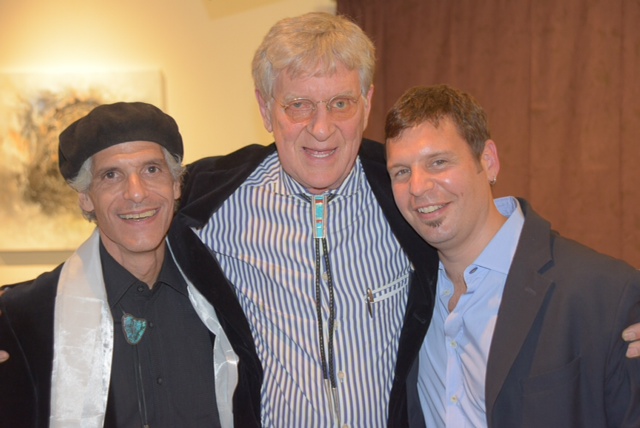
I posted a condensed version of this interview on the Psychology Today blog, but here is the interview in its entireity. Lots of good insight in here!
Increasingly, aspects of Buddhism are being incorporated into psychotherapy and mainstream healing approaches. How do you explain this integration?
Greater self-awareness, emotional-tolerance, behavioral-self-management, relaxation and empathy are all necessary for optimal mental health and well-being, yet traditional psychotherapy offers few, if any, practical methods to assist clients in cultivating these capacities between sessions. Buddhism offers a number of very effective meditation techniques designed to empower individuals to develop the skills necessary for human flourishing, which is why we have seen a systematic and large-scale attempt over the last three decades to extract, scientifically investigate, and clinically-integrate various forms of meditation into psychotherapy.
There is a recognition dawning that psychotherapy, whose origins are influenced by the Cartesian dualistic paradigm of the seventeenth century, possesses inherent limitations. Like allopathic medicine before it and the current trends towards cognitive neuroscience, traditional western psychotherapy is fundamentally a human enterprise of self-understanding and healing that is grounded in a materialistic and reductionist worldview, largely devoid of spirituality, ethics and a coherent understanding of consciousness. Conversely, Buddhist, and other non-dual ancient Indian worldviews, negate the mind-body split and thereby posses holistic, rigorous, and comprehensive psychologies. With as much scientific precision as modern physics, Buddhism has explored the nature of consciousness and reality for millennia. And yet unlike our Western scientific traditions, Buddhism not only posits that human gnosis and happiness are actually possible, it grounds the endeavor of consciously cultivating one's mind within a context of interdependence and universal ethics, motivated by an altruistic intention to assist all sentient life in their evolutionary development towards awakening. Given the ever-growing challenges of civilized living we now face on the planet, I believe we are not only turning to Buddhism for its powerful methods of meditation for personal self-healing, but also for a more coherent, comprehensive and compassionate paradigm of reality and the potential of the human mind so that we may actually direct positive evolution on social and global levels.
In psychotherapy, clinicians are familiar with treating people who suffer from psychiatric disorders or disturbances in psychological functioning. How are such conditions conceptualized from a Buddhist perspective?
From a Buddhist perspective the variety of mental disorders have a single root cause. We are all delusional to some degree because each of us possesses a distorted view of reality that contributes to our experience of suffering. Our distorted perception forces us to misapprehend things as separate, including ourselves, thus pitting us against a world of discrete entities and compelling us to gratify and defend that which we arbitrarily deem as “I”, “me”, or “mine.” If we examine the current state of affairs on this planet, we quickly see the deleterious result of holding such an erroneous view. From domestic and school violence, to drug, sex and slave trafficking, on up to cooperate greed, religious wars, the wide-spread ecological destruction.
The global problems we now confront did not occur randomly. They are created by the minds of living beings, each driven by the three poisonous forces of greed and hatred, both rooted in the fundamental ignorance of separateness. This fundamental inaccurate view divides and reifies self-and-other and forces us to look out for our own welfare and interest. It obscures the ultimate reality that we are all intimately and indelibly interconnected with each other. From this line of reason, if we harm or kill others, we essentially commit suicide. Thankfully, this fundamental ignorance is nothing more than a byproduct of adverse conditioning and not our inherent basic nature.
The good news from the contemplative science perspective is that our nature is actually open and therefore receptive to be soft-wired by our behaviors, our mental activities, and our communications. The choice is ours to exercise our mammalian instincts of cooperation and compassion, or to strengthen our reptilian instincts of mistrust and competition. Current trends in neuroscience reveal that our brains are plastic and experience-dependent; if we cleanse the doors of our perception through the development of conscious awareness and deep introspective understanding, then we will regain the profound wisdom of openness and interconnectivity, which naturally propels us into ethical and sustainable action. We will begin to relate to all things as oneself and kin, treating all beings with dignity, respect, love and compassion. Contemplative science posits that if we come to understand our true nature, then we will naturally live the more connected and contented lives that until now has eluded us.
How is contemplative psychotherapy different from "mainstream" psychotherapy?
The often misunderstood, yet profound teachings on radical openness (emptiness) and causality (karma) are the Buddha’s unique contributions to the human endeavor of self-understanding, happiness and freedom. Buddhist contemplative psychotherapy aims to help individuals access the non-dual wisdom of openness and compassion of altruistic-interconnectivity. Because our condition of suffering is causally produced rather than innate or predetermined, we can cultivate an intuitive disidentification from the root cause of suffering; the reified and traumatized sense of separate self. This naturally disarms our stress-instincts, tames our addictive and aggressive emotions, and subsequently allows us to shift out of our maladaptive behaviors and extinguish the destructive consequences on individual, social and global horizons. Contemplative psychotherapy distinguishes itself as a spiritual psychology of timeless wisdom, profound method and universal ethics through the understanding of our suffering, abandoning its causes, realizing our innate potential for freedom and cultivating a specific path towards sustainable happiness.
First, it was mindfulness. Now it's compassion (and self-compassion). What's next?
It seems that visualization practices are the next frontier. The trajectory of clinical research on meditation is intuitively following the traditional Tibetan Buddhist inner science curriculum referred to as lam rim, or gradual stages of the path to awakening. We start by establishing individual well-being and healing through insight and awareness, then develop pro-social engagement through love and compassion, and finally access heroic leadership and inspiration through role-modeling visualization and subtle-body sublimation. We have a solid foundation of the past thirty years studying mindfulness, and the past decade has begun to explore meditations that promote love and compassion. A very small handful of researchers have just started to empirically investigate powerful visualization techniques exclusive to the tantric Himalayan traditions of Tibet and India. These visualizations function as internal “flight-simulators” of love that accesses mammalian pro-social emotions and blissful neurochemistry in order to expedite the process of human evolution into more empowered, heroic, caring, global leaders. Very, very exciting stuff!
The Nalanda Certificate program looks very exciting and includes such an incredible line-up of experts! Would you tell me a little bit more about it?
We are very fortunate that luminaries and experts in the fields of Tibetan Buddhism, neuroscience and psychotherapy have signed on as faculty including Joe Loizzo, Robert Thurman, Sharon Salzberg, Daniel Siegel, Richie Davidson, and Rick Hanson. This is a truly unique program and an historic moment in Nalanda’s growth. Coming off the success of our public educational initiative called the Four Year Program in Sustainable Happiness, we wanted to target and custom design a long-term training program for health professionals. Currently there are very few training programs in contemplative psychotherapy world-wide, and surprisingly none in New York City. We wanted to make our program available to professionals practicing in the field, outfit them with contemplative science and skills of Tibet, and support their development with congenial mentors and community.
Our program was modeled after the popular certificate program offered at the Institute for Meditation and Psychotherapy in Massachusetts. We distinguish ourselves by extending the core training on mindfulness to include the Tibetan mind science of pro-social engagement and the tantric arts of role-modeling visualization and subtle body sublimation. Finally, we believe we fill a gap in the tremendous research impetus currently occurring through organizations such as Mind/Life Institute, the Center for Compassion and Altruism in Research, and the Center for the Study of Healthy Minds. These institutes scientifically establish the neurological mechanisms and health benefits of meditation, whereas we hope to complement the research with clinical training and professional development. It is one thing to know that various meditation techniques work, but an entirely other matter to have qualified instructors training future generations of health-care professionals. We ultimately hope this training will enable us meet the scale that is required to permeate our culture’s debilitated medical, therapeutic, business and educational institutions.
In some training programs, there can be an over-emphasis on intellectual or academic concerns with little appreciation for the importance of experiential learning. How will you be addressing this issue in the program?
Our program begins with an intensive four-day meditation retreat lead by core faculty Drs. Joe Loizzo, Miles Neale and Emily Wolf, along with meditation faculty Sharon Salzberg in the first year and Robert Thurman in the second year. In addition, the 30 weekly classes each year will begin with meditation, group process, and/or peer-lead meditation and feedback facilitated by Dr. Emily Wolf prior to the didactic material provided by visiting expert lecturers. Participants are also expected to maintain a commitment to a daily meditation that is supported by the local Nalanda community of mentors and friends. We believe that these essential elements of the retreat, weekly led practice, group process, didactic, mentoring and daily commitment to meditation will ensure that our program balances experiential and intellectual rigor.
When are applications due?
Rolling admissions.
Will all of the teachers be present in-person?
All instruction is live and in person.
How many participants do you plan to accept?
The program is limited to 30 to maximize instructor ratio and group process.
Is it possible for participants to attend one year, but not another?
Yes, it is possible to attend the first year for a certificate in mindfulness-based psychotherapy and continue on for a certificate in compassion-based psychotherapy, or enroll in either year separately.
How familiar do participants need to be with Buddhism?
Preference is given to those with greater exposure and who have already established a daily meditation practice, but we welcome all those interested to apply.
Who would be the ideal person to participate in it?
A mature, health-care professional, educator, coach, or trainee, who is interested in the clinical application of contemplative neuroscience, has a meditation practice and is motivate to have an impact on individuals, society and the planet.
Thanks, Miles, for speaking with me! To learn more about Miles, you can visit his website. To learn more about the Nalanda Certificate program, you can visit its page, too.

 Monday, April 20, 2015 at 11:20AM